Does an ADGM Tech Startup Licence Require a Dedicated Desk? Flexi Desk vs. Dedicated Desk, Explained
ADGM requires Tech Startup licence holders to have a dedicated desk — flexi-desking doesn't qualify. Here's what that means before you book.
ADGM office leases typically run 1-3 years — here's why flexible workspace is the practical choice for startups early on.
A founder six months into an ADGM startup usually doesn't know exactly what the team will look like in a year. Maybe there are two more hires by then, maybe six, maybe the business has pivoted into something that needs less desk space, not more. Signing a traditional multi-year office lease at this stage means betting on a shape the business hasn't taken yet — a bet with real financial consequences if it turns out wrong.
That uncertainty is the actual reason flexible workspace makes sense for startups — not just that it's cheaper, though it usually is, but that it doesn't force a guess this early.
Flexible workspace is a practical choice for ADGM startups because it doesn't require committing to a fixed space for years before the business knows its own shape. It's not automatically the right call forever — it's the right call for the period when things are still genuinely uncertain.
Traditional office leases in ADGM commonly run one to three years, based on current market listings and analyses. That's a long commitment for a business that might double its headcount, or might not, within that window. A coworking membership — a Flexi Desk or Dedicated Desk — is generally structured around shorter, more flexible terms than a fixed office lease, without the years-long commitment attached to leasing a private space directly.
Exact minimum commitment periods for Aegis memberships weren't confirmed for this article — worth checking directly with Aegis for the specific terms attached to a Flexi Desk or Dedicated Desk.
An established business with a stable team size can reasonably plan around a multi-year lease, because the assumptions behind it are more likely to hold. A startup's assumptions are the part most likely to change: hiring plans shift, funding timelines move, and pivots happen. Locking in space based on today's headcount, before any of that plays out, is a bet the business doesn't need to make this early.
Consider a two-person SaaS startup, six months old, still testing which market segment actually wants the product. Signing a three-year lease now would mean guessing at a team size and space need that could look completely different by the time the lease even reaches its second year. Starting on a Dedicated Desk keeps the decision open without slowing anything down.
Now consider a five-year-old consultancy with a stable client base and a team that's grown steadily but predictably for two years running. The uncertainty that made flexibility valuable early on has mostly resolved — a private office removes the ongoing need to think about workspace at all, which is exactly the point once the guessing is over.
The risk with a traditional lease isn't just the monthly rent — it's what happens if the guess turns out wrong. A lease signed for a ten-person team that ends up needing four, or a pivot that changes what kind of space actually makes sense, doesn't resolve itself just because the lease term hasn't ended. Exiting or subletting a traditional commercial lease early is rarely simple or cheap, and that's a cost that only shows up after the decision, not before it.
A flexible membership doesn't remove risk entirely, but it keeps the size of that risk small — the cost of guessing wrong on a Dedicated Desk is a monthly fee, not a multi-year obligation still owed regardless of whether the space is actually being used.
Beyond the lease-length question, a traditional office typically means furnishing, fitting out, and setting up internet and utilities before anyone can actually work there — costs that show up before the business has proven anything. Aegis memberships come furnished, with no setup fees, no admin fees, and no deposit required, which matters more for a startup than it might for an established business with capital already set aside for office infrastructure.
Flexibility has a natural endpoint. Once a team has a settled size, a predictable need for daily private space, and a clear sense that it isn't about to shrink or pivot dramatically, the calculation shifts. At that point, the cost of a private office (from AED 4,500 a month) starts buying something a flexible desk doesn't: a permanent, branded space with nothing to renegotiate as the business settles into its shape.
Practically, this doesn't tend to happen in the first year. It tends to happen once a startup has moved past the stage where its own future is the biggest unknown in the room.
The practical version of this isn't choosing once and living with it — it's moving along a ladder as the business changes shape:
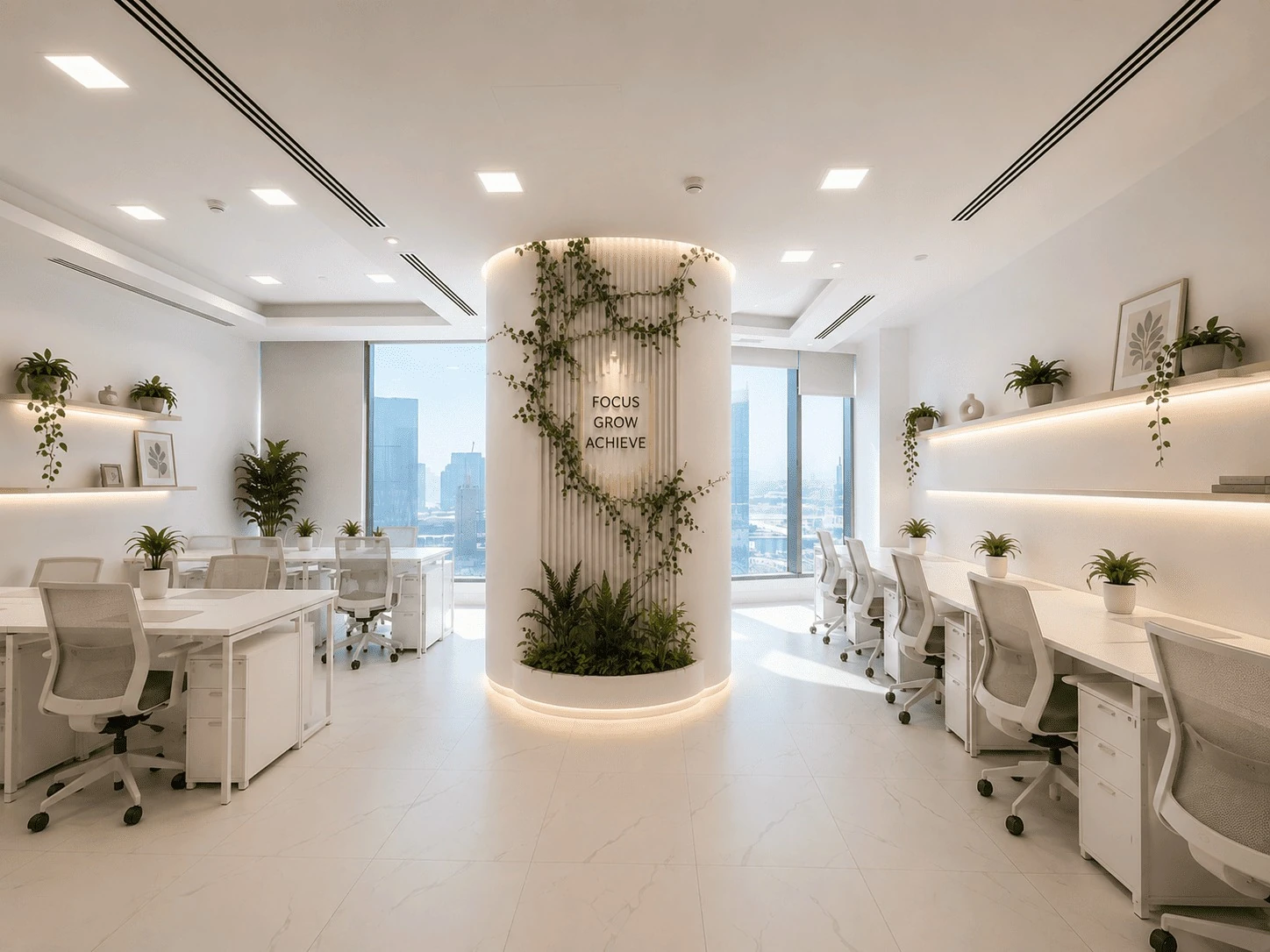
Each step is available from the same Addax Tower location, so moving up the ladder doesn't mean starting over somewhere new.
| Situation | Likely Fit |
|---|---|
| Team size and trajectory still genuinely uncertain | Flexible workspace (Flexi Desk or Dedicated Desk) |
| First few hires, need a consistent seat | Dedicated Desk |
| Settled team, predictable size, daily private space needed | Private Office |
| Not yet sure how big the team will get | Start flexible; upgrade once the shape is clearer |
Because startup team size and direction are harder to predict than an established business's, and a flexible workspace doesn't require locking in space years before that uncertainty resolves.
Traditional office leases in ADGM commonly run from one to three years, based on current market information — considerably longer than the shorter, more flexible terms typical of a coworking membership.
Not at Aegis — Flexi Desk and Dedicated Desk memberships include the same core facilities (meeting rooms, business lounge, 24/7 access) as other tiers, without the long-term commitment of a private lease.
Once team size and daily space needs are reasonably settled, rather than still changing month to month — that's the point flexibility stops adding much and a private, permanent space starts making more sense.
Yes — Day Pass, Flexi Desk, Dedicated Desk, and Private Office are all available from the same Addax Tower location, so scaling up doesn't mean relocating.
It's most valuable when uncertainty is highest, which is usually early on, but any startup still working out its team size or direction can benefit from staying flexible rather than committing to a lease around a guess.
Not in terms of the registered ADGM address or facilities available — the difference is mainly about permanence and branding, not credibility or capability.
If it's still early and the team's shape isn't settled yet, starting flexible and adjusting later is usually the lower-risk move. Message Aegis on WhatsApp or see full office space details to compare where to begin — the goal is matching the workspace to how much is actually known about the business right now, not to how big it might eventually get.
.webp)